Supervisor Advantage

Lead.

A Supervisory Leadership Tool

Close the Gap between Leadership Theory and Leadership in Action.

Confidence in Leadership

Turn leadership theory into leadership in action.

Leadership training is filled with principles, models, and classroom examples. The challenge begins when the supervisor returns to the workplace and has to decide what to notice, what to document, what to follow up on, and what action to take next. Supervisor Advantage is designed to close that gap between learning about leadership and actually doing the work of leadership.

Systems

Leadership creates the conditions for behavior

Organizations put principles into practice through systems: expectations, routines, tools, incentives, training, resources, and processes. Those systems make certain employee behaviors easier, harder, more likely, or less likely.

Behaviors

Supervisors observe what the system is actually producing

The supervisor stands at the point where the system becomes visible. By observing what employees actually do, the supervisor can determine whether the intended behaviors are occurring, whether support is needed, and whether the system is working as designed.

Feedback

Observed behavior must flow back into the system

When the desired behavior does not occur, the answer is not simply to wait for poor results. The supervisor uses observations, coaching, follow-up, and documentation to ask what in the system must be clarified, strengthened, simplified, reinforced, or changed.

Different schools of thought. One recurring pattern.

Deming, Shingo, Senge, James Clear, B.J. Fogg, O.C. Tanner, and other management and behavior thinkers use different language and focus on different parts of leadership, but their work converges around a similar relationship: systems shape behavior, behavior provides evidence about the system, and the resulting behavior determines whether the organization will realize the results its principles intend.

Deming — Improve the system rather than blaming the worker.
Shingo — Principles are expressed through systems that produce behaviors. When the system is adequate the expected results will be realized.
Senge — Mental models and organizational structure (systems) shape behavior over time.
James Clear — Shape the environment (system) so the desired behavior becomes easier to repeat and more likely to become habitual.
B.J. Fogg — Examine whether the system provides sufficient motivation, ability, and an effective prompt for the desired behavior to occur.
O.C. Tanner Institute — Make recognition part of the everyday flow of work (system) so appreciation is timely, specific, personalized, and connected to meaningful employee contributions (behaviors).

Supervisor Advantage is the action engine in the feedback loop

Supervisor Advantage operates inside the relationship between systems and behavior. It helps the supervisor observe behavior, document what occurred, reinforce what is working, address what is not, and carry that information back to the system. The dashboard then prompts the next action so the loop continues while there is still time to improve performance.

System — leadership establishes the expectations, processes, tools, training, and conditions intended to produce the right behavior.
Behavior — the supervisor observes what employees actually do in the real workplace.
Response — the supervisor recognizes, coaches, follows up, creates an agenda item, or prepares a growth and development discussion.
System adjustment — observations reveal whether the system is increasing the desired behavior or whether something must be changed.
Realized results — when the system reliably produces behavior aligned with organizational principles, the intended results become more likely.

Why this creates confidence

Confidence does not come from pretending to have every answer. It comes from working a sound feedback process. Do the dashboard. Observe the behavior. Respond while the moment is current. Follow up. Then use what you learned to confirm or improve the system. Supervisor Advantage turns a shared principle of management and behavioral science into daily leadership action.


Social Edge

Never forget a name.

Social Edge helps supervisors remember the people they lead, recognize the people around them, and steadily expand their professional network. Keep names, roles, groups, memory hooks, and useful personal context in one place so you can walk into everyday interactions with greater confidence.

Know Your People

Remember employees as people

Keep names, roles, groups, and personal context organized so coaching, meetings, recognition, and evaluations begin with a clearer understanding of the person in front of you.

Be Ready

Know who you are likely to meet

Use filter chips to quickly narrow your contacts by workplace, group, neighborhood, event, or other shared context before you arrive somewhere you may run into employees, executives, neighbors, or business associates.

Grow Your Network

Build stronger professional connections

Social Edge is not limited to direct reports. Use it to remember executives above you, colleagues beside you, community contacts, and new business relationships as your network grows.

Never forget a name — avoid the awkward moment of recognizing someone but being unable to place who they are.
Prepare before you arrive — filter by group so the people you are most likely to see are already fresh in your mind.
Lead more personally — remember the details that help employees feel known rather than processed.
Connect in every direction — strengthen relationships with employees, peers, executives, neighbors, and business associates.
Use the power of a name — few things make an interaction feel more personal than being remembered and addressed by name.
Be more present with your employees

Observe. Record. Repeat.

Consistent observation is at the heart of effective supervision. It is how a supervisor can determine whether the behaviors happening every day are aligned with the principles of the organization and therefore whether the expected results will be realized.

is, above all else, an easy way to document those observations quickly while the work is happening. Pull out your phone, record the observation, and get back to your day.

Because documentation is easy, supervisors are more likely to do it consistently. This follows the principles of modern behavioral psychology. Those on the fly observations can then lead directly to a follow-up appreciation note, a real time coaching moment, or a growth and development discussion when a behavior needs attention.

Appreciation in the moment

Turn a positive observation into a timely note of appreciation.

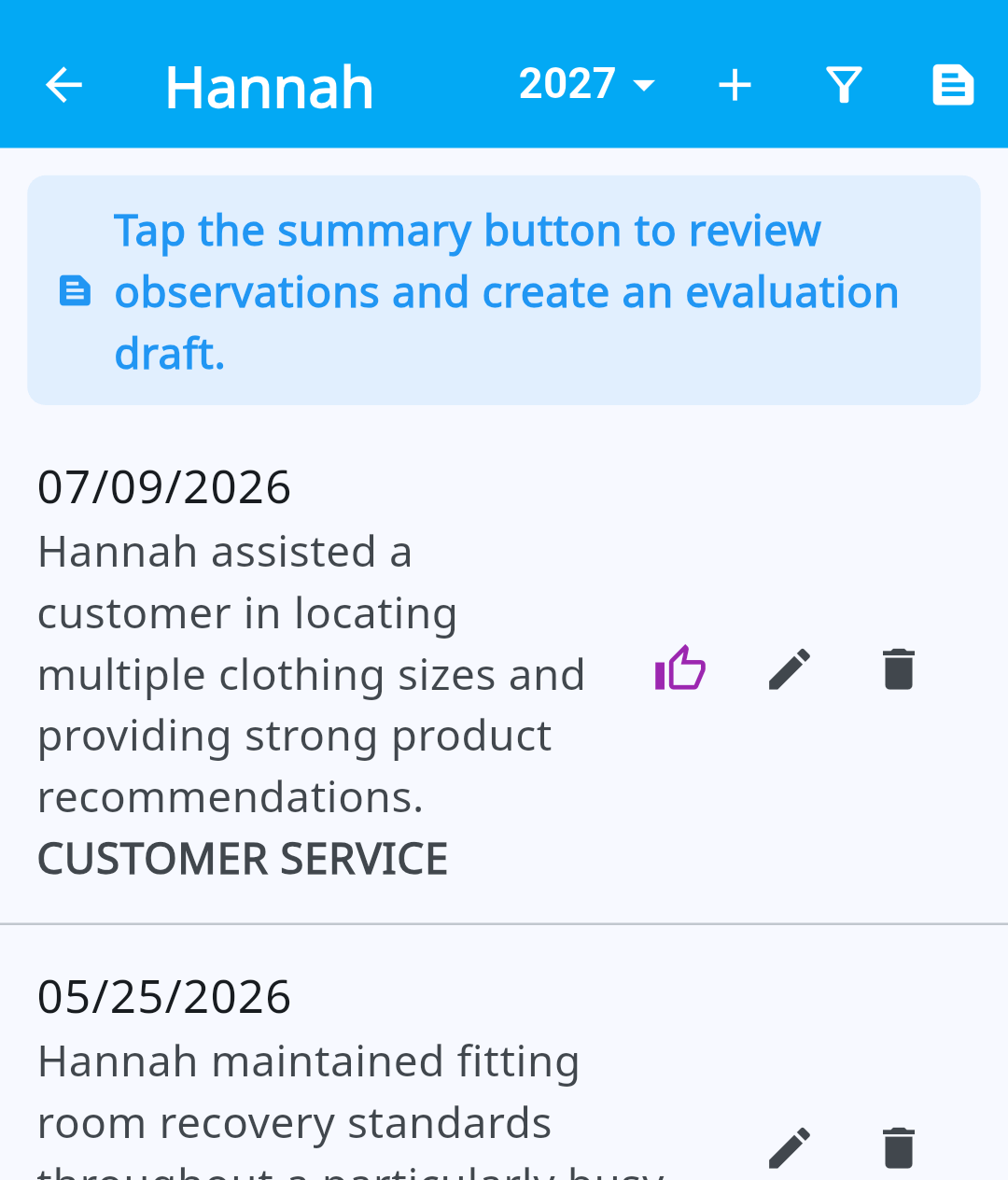
Within 48 hours of recording a positive observation, the dashboard prompts the supervisor to tap the thumbs-up icon and send a short note of appreciation by text or email.

Because the note begins with a real observation, the appreciation is specific. It reinforces the exact behavior the supervisor wants to see continue instead of offering vague or generic praise.

This is supported from two directions. Behavioral psychology explains why timely feedback can reinforce a behavior. O.C. Tanner’s workplace-recognition research emphasizes that meaningful recognition should be timely, specific, personalized, and integrated into the everyday flow of work. Supervisor Advantage makes that kind of recognition easier to deliver while the contribution is still fresh.

Close-up of the thumbs-up appreciation prompt in Supervisor Advantage
Build the agenda as you go

Walk into meetings with relevant topics already prepared.

As supervisors move through the workplace, they do more than observe individual employees. They also notice issues, patterns, questions, and opportunities that may need to be addressed with the staff as a whole or brought to a particular meeting.

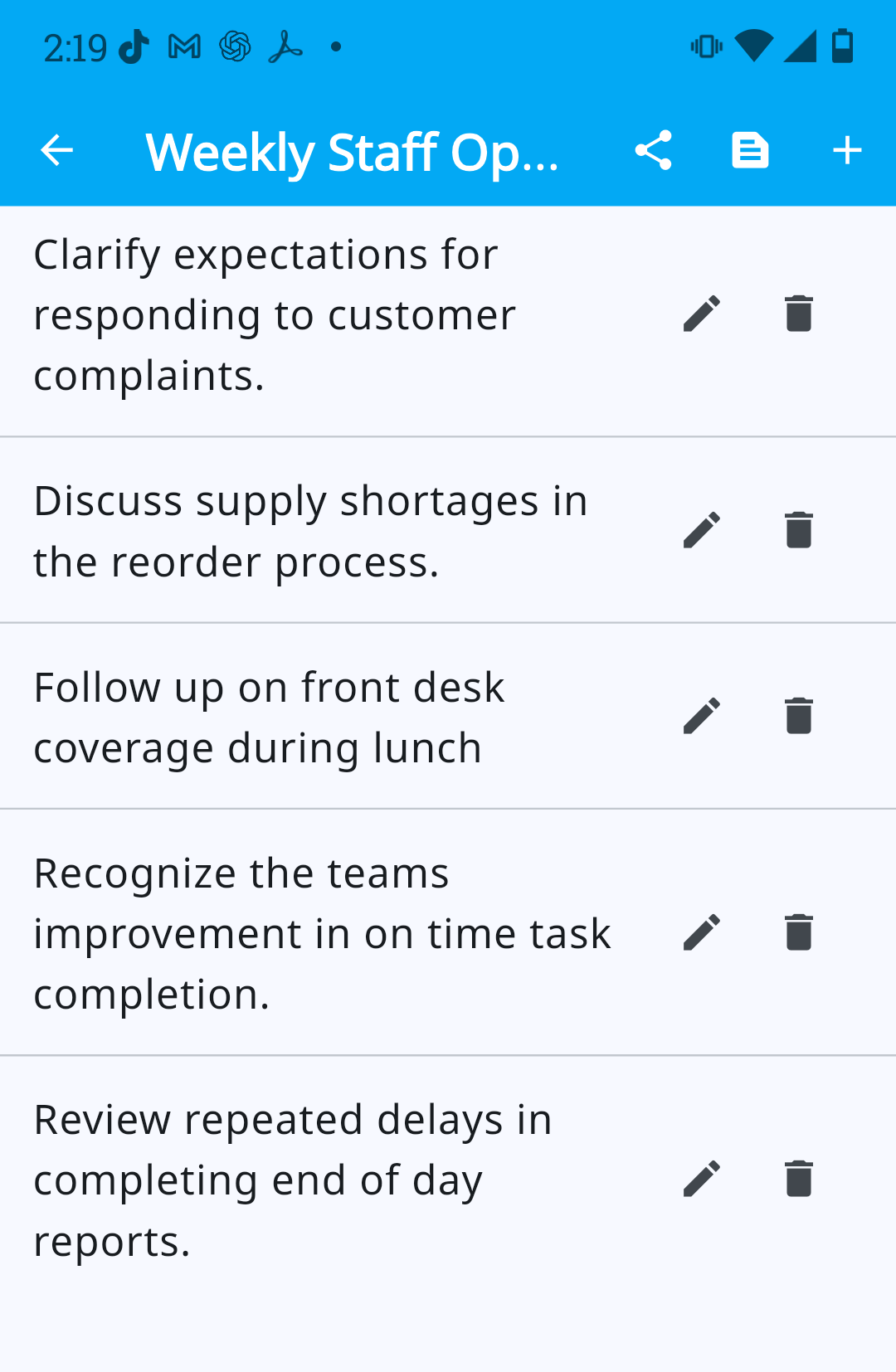
In Supervisor Advantage, you create the meetings you regularly hold and add each issue to the appropriate meeting as an agenda item. When the meeting arrives, you already have a current list of recent, relevant topics instead of trying to remember everything at the last minute.

Agenda items also support follow-through. As you continue walking around and observing the workplace, you can revisit earlier topics and determine whether the issue was fixed, whether action was taken, or whether it needs to return to the agenda.

Agenda items for a weekly staff operations meeting

What does do?

The simple version is this:

Supervisors are responsible for evaluating, coaching, recognizing, and remembering the people they lead.
That work becomes harder when important moments are scattered across memory, notebooks, emails, documents, and sticky notes.
helps supervisors capture talk-to-text notes throughout the year and decide how each note should be used.
When a formal document is needed, helps turn the right observations into professional drafts quickly.

Built for the real supervisory workflow

was created to reduce the scramble that happens when supervisors are forced to reconstruct months of employee performance, growth, context, and follow-up from memory or scattered notes.

Observation Capture

Record useful notes as work happens

Capture strengths, growth areas, and important context while they are still fresh so leadership decisions are based on real examples instead of last-minute memory.

Smart Use

Decide where each note belongs

Mark observations for evaluations, growth discussions, recommendation letters, appreciation reminders, or private supervisor context.

Draft Support

Turn notes into professional drafts

Use stored observations to create clear drafts that supervisors can review, edit, personalize, and use with professional judgment.

Coach as you go

Coach as you go.

You cannot wait for the results before making strategic decisions. The results are too late. That would be like coaching a soccer game by learning only the final score. Supervisors need to observe what is happening while there is still time to respond, reinforce, redirect, and improve.

Observe

See behavior before it becomes a result

Make specific observations while the work is happening. This gives supervisors real evidence of what employees are doing well, where support is needed, and whether day-to-day behavior is moving the organization toward its intended results.

Coach

Connect behavior to principles and systems

Use follow-ups and growth and development discussions to determine whether observed behaviors reflect the organization’s principles, expectations, and the intent of the systems leadership has put in place.

Strengthen

Improve performance while change is still possible

Document the conversation, follow through, and continue observing. By evaluation time, the goal is not to surprise the employee with old results. It is to evaluate the strongest version of an employee who has been coached throughout the year.

Know whether leadership is working

Real-time observation is how supervisors can tell whether executive leadership is successfully translating organizational principles into systems, systems into behavior, and behavior into intended results. Without observing and coaching the behavior, leaders see only the final score—and by then, the opportunity to influence it has passed.

Growth & Development Discussion Outlines

Be more confident during tough discussions when employees are in need of improvement.

Supervisor Advantage makes the difficult growth and development conversations easier because you enter it with a clear goal, a structured outline, and specific observations to work from. When Supervisor Advantage creates a growth and development disscussion outline, it is will analyze for discrepancies between the observed behavoir and the expected behavoir. It will then provide the supervisor with questions which may uncover the reason for the discrepancy.

Discussion Outline

Know how to address the situation

The app creates a draft called a Growth and Development Discussion Outline. It gives the supervisor a structure for addressing a difficult situation instead of entering the conversation unsure of how to begin, what to ask, or where the discussion should lead.

Behavior Analysis

Compare observed behavior with expected behavior

The outline analyzes the behaviors captured in your observations and compares them with the expected behaviors of a professional employee. It then helps you ask the questions needed to understand why a discrepancy exists between what was observed and what was expected.

Dashboard Follow-Up

Follow up before the problem grows

When you record a growth and development observation, the dashboard creates a follow-up reminder shortly afterward. That means you are prompted to coach and check in before the situation reaches the point where a formal sit-down discussion is required.

The goal is not confrontation. The goal is clarity.

The outline helps the supervisor enter the conversation knowing what behavior was observed, what behavior was expected, and what questions need to be asked to understand the gap. That structure creates a clearer path toward correction, support, and follow-through.

Interested in Supervisor Advantage?

Supervisor Advantage is built for supervisors, managers, administrators, and organizational leaders who want a practical system for turning leadership principles into consistent action. To learn more, ask a question, or discuss access, contact John Lawrence directly.